Direct hair implantation (DHI): An emerging approach to modern hair transplantation
‹ All media & insights
By Oma Agbai, MD, FAAD | Board-Certified Dermatologist | NorCal Hair Doctor™
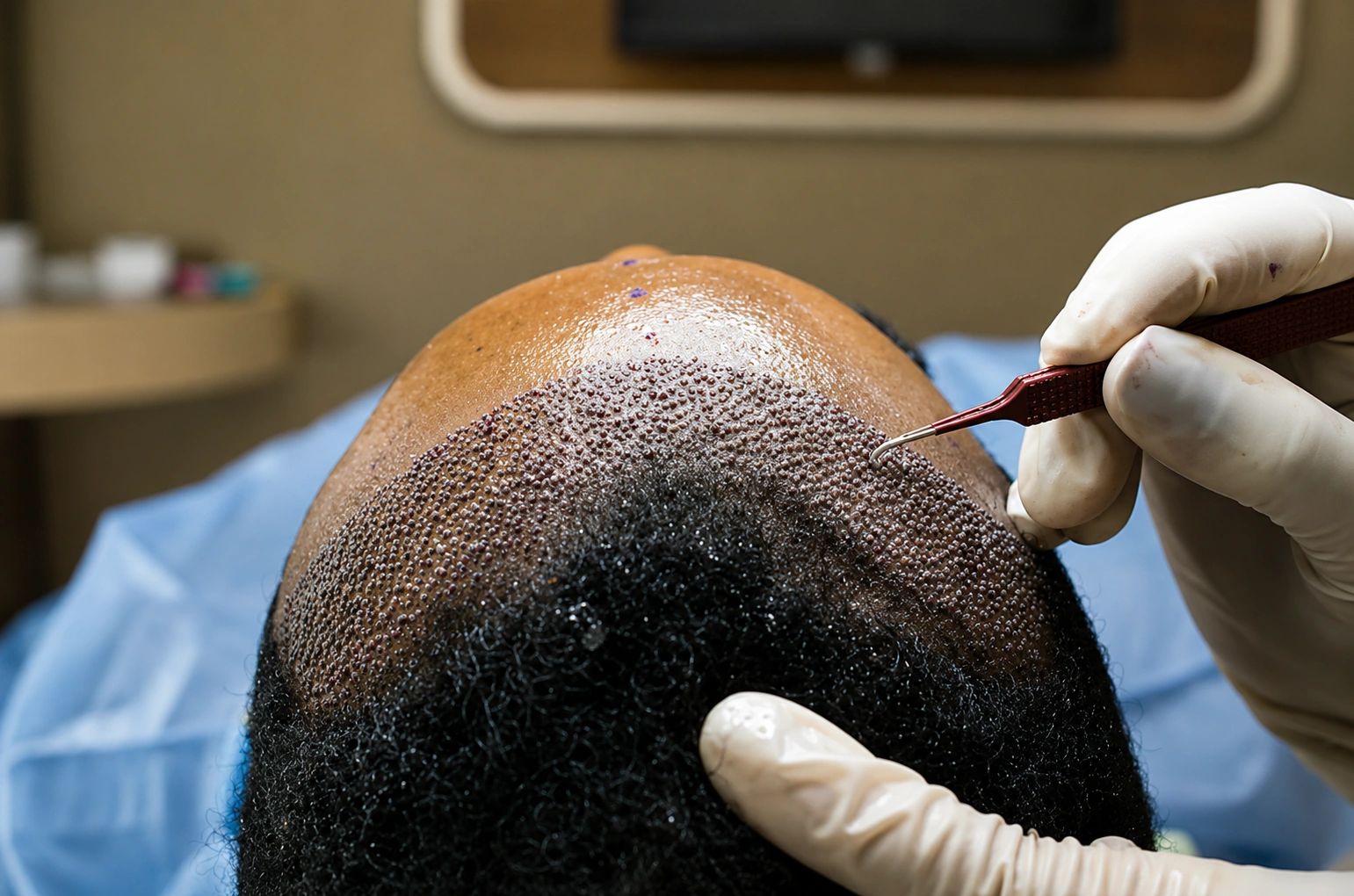
Hair transplantation has evolved significantly over the past several decades. Today, one technique receiving increasing attention is Direct Hair Implantation (DHI), an approach that uses a specialized implanter device to place individual hair grafts directly into the scalp.
Patients searching for the latest hair transplant techniques, DHI hair transplant, or FUE vs. DHI hair transplant may see DHI described as an entirely new type of hair transplant. In reality, the distinction is a little more nuanced. DHI is best thought of as an advanced method of implanting hair grafts rather than a completely different method of harvesting them.
What is Direct Hair Implantation?
In a typical Follicular Unit Extraction (FUE) hair transplant, naturally occurring follicular units containing one or more hairs are individually removed from the donor area, usually at the back and sides of the scalp.
After the grafts are harvested, they must be transplanted into the areas affected by hair loss.
With traditional FUE placement, the surgeon may first create tiny recipient sites in the scalp using a needle or blade. The follicular unit grafts are then carefully inserted into these pre-made sites.
Direct Hair Implantation, or DHI, changes the implantation step.
Instead of creating all of the recipient sites first and then placing the grafts, a specialized hair implanter pen can be used to create the recipient site and place the follicular unit in a single controlled maneuver. This approach is also sometimes referred to as the sharp implanter technique or a form of “stick-and-place” hair transplantation.
How does a DHI hair transplant work?
The first part of an FUE procedure remains essentially the same. Individual follicular units are carefully harvested from the donor scalp and prepared for transplantation.
For DHI placement, each graft is gently loaded into a hollow implanter needle. The surgeon positions the device at the desired location, angle and direction within the recipient area. The sharp tip enters the scalp, and the graft is then deployed directly into its new position.
Because the recipient site and graft placement can occur as part of the same maneuver, DHI gives the surgeon another tool for controlling the architecture of the transplant one follicular unit at a time.
This is particularly important because a successful hair transplant involves much more than simply moving hair from one location to another. The angle, direction, distribution and density of transplanted hairs all contribute to how natural the final result appears.
The Lion Implanter: precision graft placement
In my hair restoration practice, we use the Lion Implanter as one of our tools for follicular unit placement.
The Lion Implanter is a specialized sharp hair implanter designed for direct graft placement. A follicular unit is loaded into the hollow needle of the device, allowing the surgeon to create the recipient site and deliver the graft during the same step.
Different needle sizes can be selected based on the size and characteristics of the follicular unit being transplanted. This is useful because a single-hair follicular unit used to create a soft, natural hairline is very different from a larger two- or three-hair graft that may be used farther behind the hairline to build density.
The Lion system is designed to facilitate precise control over implantation angle and spacing, while its needle design allows the graft to be delivered directly into the recipient site. The manufacturer describes the system as combining recipient-site creation and follicular-unit insertion into a single step.
For the surgeon, this provides another level of control when designing a hairline and determining exactly how individual hairs should emerge from the scalp.
Why is DHI becoming more popular?
One reason for the growing interest in DHI hair transplantation is the emphasis on precision.
Hair does not naturally grow straight out of the scalp. At the frontal hairline in particular, hairs often emerge at very acute angles and change direction as they move across the scalp. Reproducing those patterns is one of the artistic components of hair restoration surgery.
Implanter devices allow the surgeon to determine the position, angle and direction of individual grafts as they are placed. They can also reduce the need to manipulate the graft with forceps during the actual insertion process.
Another potential advantage is flexibility. Sharp implanters can be useful when transplanting among existing hairs because recipient sites can be created and populated sequentially rather than preparing an entire field of empty recipient sites beforehand.
However, it is important to separate the potential technical advantages of DHI from some of the marketing claims surrounding it. There is not currently strong evidence demonstrating that DHI is universally superior to high-quality FUE transplantation using carefully created recipient sites and traditional graft placement.
Ultimately, the skill of the surgeon, appropriate patient selection, careful graft handling, donor management and thoughtful hairline design remain more important than the name of the implantation device.
DHI vs. FUE: What’s the difference?
This is one of the most common questions patients ask.
In many cases, DHI is actually performed as part of an FUE hair transplant.
Think of the procedure as having two major components:
Harvesting: How are the follicles removed from the donor area?
Implantation: How are those follicles placed into the recipient area?
With an FUE + DHI hair transplant, follicular units are harvested individually using FUE and then implanted using a sharp implanter such as the Lion Implanter.
By comparison, another FUE procedure may use the same general extraction technique but create recipient sites first and subsequently place the grafts into those sites.
For this reason, asking whether “DHI or FUE is better” does not always capture the full picture. The better question is: Which extraction and implantation strategy is most appropriate for my hair loss pattern, donor supply, hair characteristics and restoration goals?
Is DHI better for creating a natural hairline?
DHI can be an excellent tool for precision hairline restoration, but the device itself does not create a natural hairline. The surgeon does.
A natural-looking hairline requires thoughtful design, including irregularity rather than an unnaturally straight border, appropriate placement of single-hair grafts at the leading edge, careful transitions in density, and precise control of hair direction and exit angle.
An implanter such as the Lion Implanter can help the surgeon execute that plan by providing controlled placement of individual follicular units.
This combination of science, surgical technique and aesthetic design is what ultimately determines whether a hair transplant looks natural.
Who may be a candidate for DHI hair transplantation?
DHI may be considered for appropriately selected men and women undergoing hair transplantation for conditions such as androgenetic alopecia (male or female pattern hair loss) and certain other forms of stable hair loss.
It may also be incorporated into carefully selected hair restoration procedures where precise placement among existing hairs is desirable.
For patients with scarring alopecia, including central centrifugal cicatricial alopecia (CCCA), lichen planopilaris (LPP) and frontal fibrosing alopecia (FFA), the first priority is different. The inflammatory hair-loss condition should be appropriately diagnosed and stabilized before surgical restoration is considered.
That is why my approach to hair restoration follows three steps:
Diagnosis. Stabilization. Restoration.
The most technologically advanced hair transplant cannot compensate for an incorrect diagnosis or an actively progressing hair-loss disorder.
DHI is a tool, not a substitute for medical expertise
As DHI becomes more visible online, patients may encounter claims that one device or technique automatically produces greater density, higher graft survival or better results.
Hair transplantation is more complex than that.
Modern implanters such as the Lion Implanter provide surgeons with sophisticated tools for precise follicular-unit placement. But successful hair restoration still depends on selecting the right patient, preserving the donor area, protecting grafts during surgery, designing an age-appropriate hairline and placing follicles according to the natural direction and pattern of the patient’s hair.
For some patients, direct implantation may be an excellent choice. For others, traditional recipient-site creation followed by graft placement may be preferable. In some cases, a surgeon may incorporate more than one placement technique within the same procedure.
The goal should not simply be to perform the newest technique. The goal is to select the technique that gives each patient the best opportunity for a natural, durable and medically appropriate hair restoration result.
Considering DHI or FUE hair transplantation?
If you are considering a DHI hair transplant, FUE hair transplant, or hair transplant in Sacramento or Northern California, the first step is determining the cause of your hair loss and whether transplantation is appropriate for you.
A comprehensive hair restoration consultation with NorCal Hair Doctor™ evaluates your diagnosis, current hair-loss activity, donor density, hair caliber and curl pattern, scalp health, medical treatments and long-term goals before developing a surgical plan.
Modern techniques such as FUE and Direct Hair Implantation with the Lion Implanter give us increasingly sophisticated ways to move and position individual follicular units. When those technologies are combined with careful medical evaluation and individualized surgical planning, hair transplantation can be tailored to create results designed to look natural not only today, but for years to come.
Diagnosis. Stabilization. Restoration.
Ready to explore your hair restoration options?
If you’re considering DHI, FUE, or other hair restoration treatments, schedule a consultation with Dr. Agbai to receive a personalized evaluation of your hair loss, donor area and restoration goals. Together, we can determine which approach is best suited to your diagnosis and long-term needs.
Schedule your hair restoration consultation today and take the next step from diagnosis to stabilization to restoration.