By Oma Agbai, MD, FAAD | Board-Certified Dermatologist | NorCal Hair Doctor™
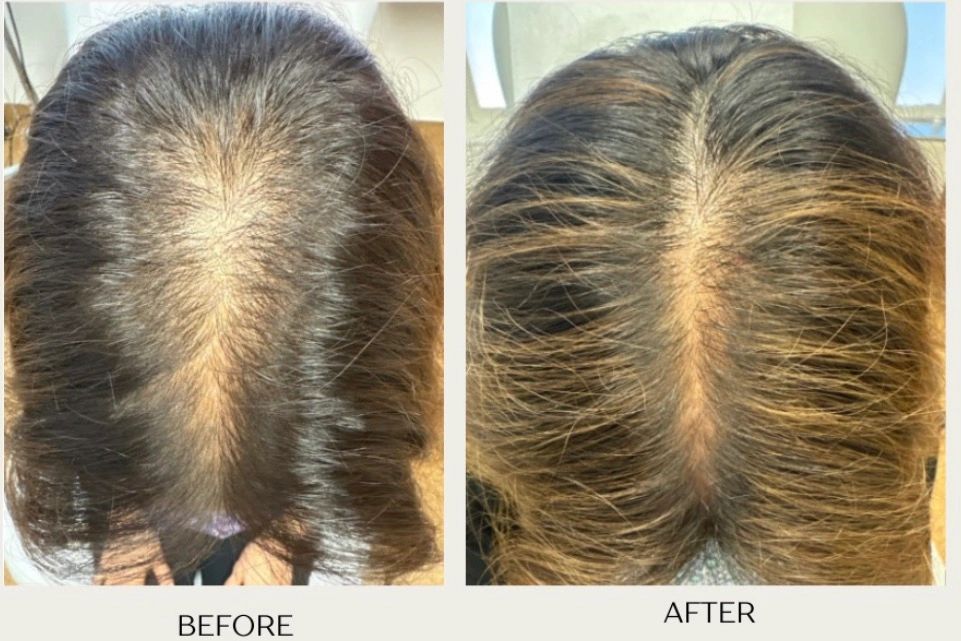
Hair transplantation has long been considered out of reach for patients with scarring alopecia. Today, with advances in medical therapy and surgical planning, that perspective is changing. In carefully selected and stabilized patients, hair restoration can offer meaningful, natural-looking results.
A changing standard in hair restoration
For many patients with scarring alopecia, the message has historically been definitive: hair transplantation is not an option.
This was rooted in legitimate concerns about inflammation, graft survival, and the unpredictable course of these conditions.
But as our understanding has evolved, so has what is possible.
With appropriate medical management and careful timing, hair transplantation is now being reconsidered as a viable option for select patients.
What is scarring alopecia?
Scarring alopecia refers to a group of conditions in which inflammation damages the hair follicle.
If left untreated, this process can lead to permanent hair loss.
Common forms include:
Central Centrifugal Cicatricial Alopecia (CCCA)
lichen planopilaris
fibrosing alopecia in a pattern distribution
These conditions are often chronic and require ongoing medical therapy to control inflammation and prevent progression.
What the research tells us
Recent clinical studies evaluating hair transplantation in patients with scarring alopecia offer important insights.
Findings include:
Graft survival may be lower than in non-scarring hair loss, but remains clinically meaningful.
Transplanted density can decrease modestly over time, yet still shows sustained improvement from baseline.
Patient satisfaction is high when expectations are thoughtfully set.
Some patients may benefit from staged or additional procedures.
In well-selected patients whose disease is properly controlled, studies suggest that long-term graft survival can approach 70% to 80%, even several years after transplantation.
Why stability is essential
Hair transplantation does not treat the underlying cause of hair loss.
If inflammation remains active, it can affect both existing hair and newly transplanted follicles.
For this reason, stability is critical.
In most cases, this means:
Demonstrating control of the condition with medical therapy
Maintaining stability for at least 6 months, and often longer
Continuing treatment before and after the procedure
This step is what allows transplantation to be performed more safely and with more predictable results.
What patients can expect
Hair transplantation in scarring alopecia is approached differently than in pattern hair loss.
The goal is thoughtful restoration, not overcorrection.
Patients can expect:
improvement in density rather than complete restoration
gradual hair growth over several months
the possibility of requiring more than one procedure
ongoing medical therapy to maintain results
When performed in the right setting, outcomes can be both natural and meaningful.
A more comprehensive approach to care
One of the most important shifts in modern hair restoration is the move toward integrated care.
The best outcomes are achieved when hair transplantation is part of a broader plan that includes:
accurate diagnosis
medical stabilization of the condition
careful surgical planning
long-term follow-up
This approach allows for better patient selection, improved graft survival, and more durable results.
The takeaway
For patients with scarring alopecia, hair transplantation is no longer automatically off the table.
With the right diagnosis, proper stabilization, and expert planning, restoration may be possible.
The question is not simply whether hair transplantation can be done, but when and how it should be done.
A more thoughtful next step
Hair loss in the setting of scarring alopecia can feel definitive, but in many cases, it is more nuanced than it first appears.
The most important step is not deciding on a procedure, but understanding your diagnosis and whether your condition is stable.
A comprehensive consultation with NorCal Hair Doctor™ allows for a careful evaluation of your scalp, your history and your long-term goals. From there, a plan can be developed that is both medically sound and thoughtfully aligned with what is possible.
For some patients, that path may include hair transplantation. For others, it may begin with stabilization.
Either way, clarity is where meaningful restoration begins.